











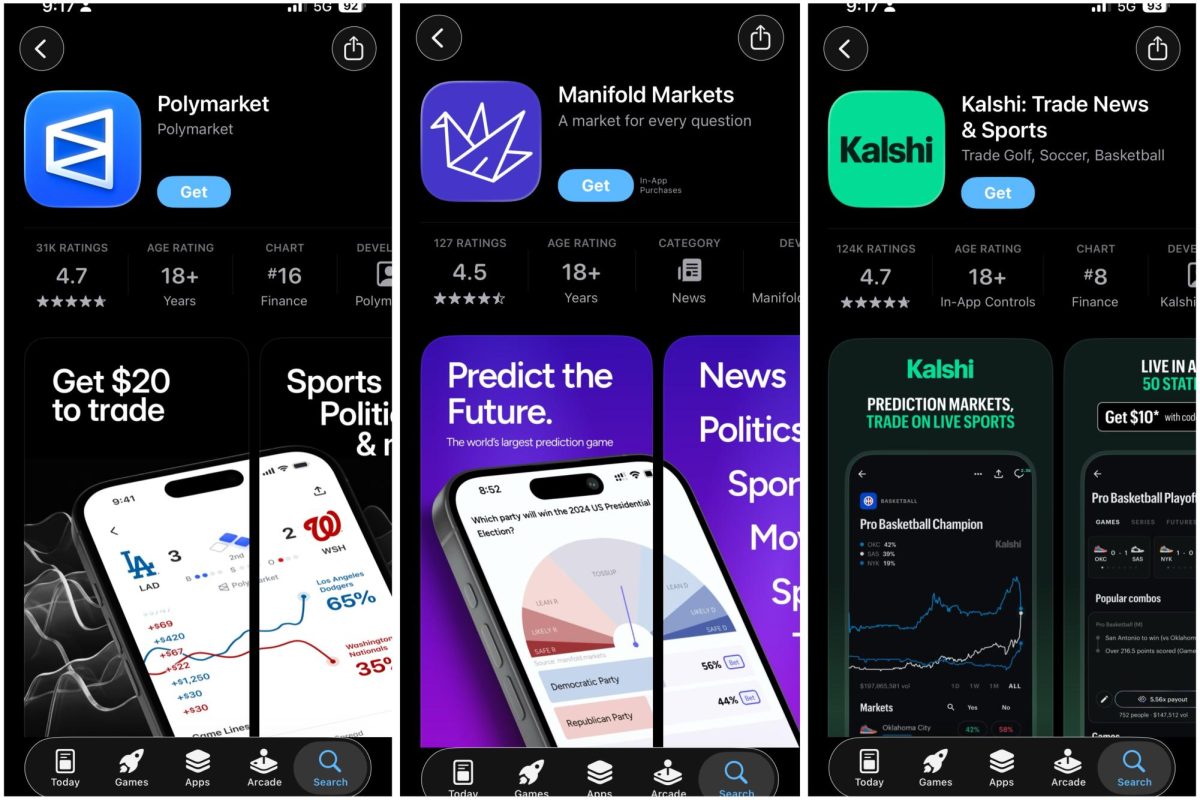


















Recently, the popularity of prediction betting has increased dramatically as the market expands rapidly alongside the mass consumption of digital media. In prediction markets such as Kalshi, PredictIt and Polymarket, individuals place wagers on the likelihood that a certain event will occur. These market shares are often binary: they only have two opposing outcomes, yet the simplicity ends there. Common shares are sold based on events regarding politics, prominent public figures and sports. While in the category of athletics, these predictive markets often mirror sports betting— gamblers placing bets on scores, specific over/unders, playtimes, etc.— in situations outside of this category, these markets tend to diverge into a unique specialization of gambling in which the options are limitless for bettors.
Investopedia reported that“Participants buy and sell shares in the outcomes of future events — from elections and geopolitics to financial markets, sports, and entertainment — and trades are matched between users, not against the house.”
These shares are often labeled as “contracts” so as not to be regulated under federal gambling legislation, a legal loophole driven by vague terminology. The Commodity Futures Trading Commission, or CFTC, has limited authority over political prediction markets because its jurisdiction focuses primarily on illegal activity rather than predictions involving federally sanctioned events such as elections. A legal analysis published by Vanderbilt University Law School argues that prediction markets continue to operate in a regulatory gray area because existing gambling and financial laws were not designed specifically for these platforms.
To continue their global impact, these markets must be careful in how they differentiate themselves from casinos and other sports betting markets that have been fully regulated and understood for decades. According to legal analysis published by Vanderbilt University Law School, Kalshi “has supplied derivative contracts under the CFTC jurisdiction since 2020 as a Designated Contract Market.” The analysis also explains that derivatives are financial contracts set between two parties that ‘derive [their] value from an underlying asset, a group of assets, or a benchmark.’” These companies benefit from operating within a relatively new industry where regulation and oversight have struggled to keep pace with rapid growth.
Prediction markets use strategies within their advertisements and promotions that tend to target those who are more likely to need or want financial assets. This population has grown drastically alongside the promotion of pyramid schemes and personal-financial development courses, both of such popularized through social media, where minors are at a heightened risk due to their incompletely matured cognitive development. According to a Fordham University study, gambling addiction clinicians say that these programs generate the same “cycle of that anticipation, action and reaction” that traditional gambling does.
Along with their addictive properties, the appeal is increased with publicity, developing a presentation of “easy money” where every player is able to win. Unlike other gambling corporations, these don’t advertise risk by acknowledging the possibility of addiction by connecting players to addiction support services. These parallel markets achieve the same facade of ease and benefit, yet prediction markets have a less obvious risk of loss, leading to their popularity to boom and revenue to skyrocket.
Unlike casino games, which—through rigorous security measures and casino oversight—rarely allow for room for cheating, prediction betting markets raise concerns about legitimacy: what’s stopping users from forcing an outcome? Insider trading is the illegal use of confidential or simply non-public information to trade securities and stocks. Polymarket claims that “the system works because traders are motivated to act on their expertise and trust that no one is gaming the outcome” in their assurance of market integrity statement. However, critics argue that some Polymarket users have manipulated outcomes by influencing events tied to contracts on which they had placed bets, a practice they describe as a form of insider trading. For a specific Women’s National Basketball Association game, hundreds of wagers had been placed on the event that “explicit objects” would be thrown onto the court during the game. A multitude of Polymarket users took advantage of this opportunity and bought tickets for the game, ultimately forcing this predicted outcome. This was not a lone occurrence. Data breaches have become a common occurrence alongside the rise of prediction betting, especially within high-value contracts regarding politics. Earlier this year, there was an anonymous trade just days before Maduro was captured from Venezuela’s capital, according to Fortune Magazine. This seemingly long-shot wager led to a $436,000 profit for the anonymous Polymarket user. Even though this specific individual was arrested, many other accounts go unnoticed. These accounts are often created mere days before small pieces of data leaks, placing large bets on outlandish possibilities. This level of insider trading has only grown.
In the coming decisive years, the awareness and rejection of prediction betting is a necessity. Acceptance and complacency only elicit a heightened sense of security for these companies in their expanding addictive position. Many states, such as Hawaii, have advanced legislation restricting these markets due to their gross similarity to sports betting and gambling companies that have already been denied to those residing in those states. Moving forward, it is unclear where these companies will end up and, perhaps more concerning, what lengths they may go to in pursuit of profit.